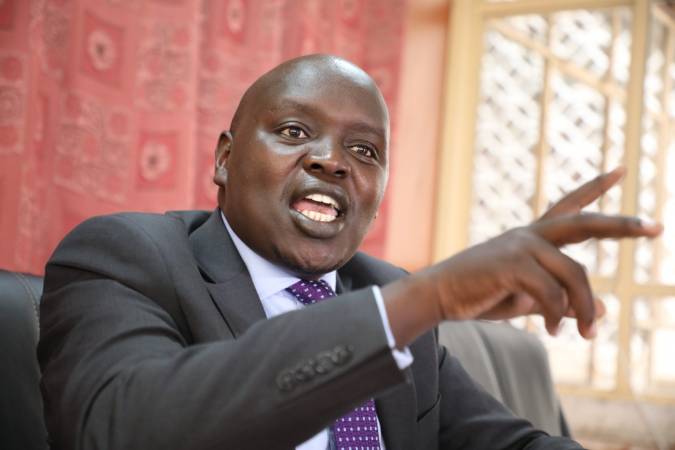
In an extraordinary escalation of Kenya’s unfolding political realignment, Nandi Senator Samson Cherargei — a prominent UDA loyalist and one of President William Ruto’s most aggressive defenders — is now openly calling for a purge inside the ODM Party, targeting Siaya Governor James Orengo, ODM Secretary-General Edwin Sifuna, and every senior ODM figure resisting the “broad-based government” pact.
This is not an internal dispute.
This is a ruling party senator attempting to shape — even sanitize — the leadership of a rival party.
His demands raise urgent questions:
Why is a UDA senator leading a campaign to restructure ODM?
Who benefits politically if Orengo and Sifuna are dislodged?
And is this the start of a silent takeover of ODM’s national direction under the broad-based government banner?
Cherargei has never been a member of ODM. He is a core figure in President Ruto’s UDA Party, a frequent defender of State House policy, and one of the loudest voices pushing for full compliance with the broad-based arrangement.
Yet in recent days, he has positioned himself as the self-appointed enforcer of, allegedly much-needed ODM discipline.
He accuses Orengo, Sifuna, and other ODM heavyweights of:
“sabotaging the broad-based government”
“undermining national unity”
“working against the spirit of Raila Odinga’s legacy”
“being political parasites and scavengers”
His conclusion is blunt and unprecedented:
ODM must be cleaned up — starting with Orengo and Sifuna.
That call, coming from outside ODM, signals something larger:
a political strategy to weaken or neutralize internal opposition to the government from within ODM’s top tier.
Cherargei seized on the Saturday pronouncement by Mama Ida Odinga, which asserted that Senator Dr. Oburu Odinga is the party leader under the broad-based arrangement. This statement has been circulated widely by pro-government networks.
For Cherargei, it was the final “seal of authority” needed to demand a purge:
“Thank you Mama Ida Odinga for putting this matter to rest…
Now the final part is cleaning ODM of political parasites like Orengo and Sifuna.”
If the Odinga family has allegedly endorsed Oburu’s leadership in the new dispensation, then anyone resisting the broad-based pact — especially Orengo and Sifuna — is defying the party’s founders.
This alignment — real or politically engineered — gives UDA loyalists rhetorical ammunition.
Why these two?
James Orengo
A respected constitutional lawyer
A long-time defender of ODM’s independence
A vocal skeptic of the broad-based government’s terms
A counterweight to attempts at external political capture
Edwin Sifuna
ODM SG and the custodian of the party machinery
Controls nominations, communication, and strategy
Seen as the primary obstacle to a full ODM–UDA merger of interests
Resists attempts to sideline or silence ODM’s opposition role
By targeting both the party’s ideological voice (Orengo) and its organizational backbone (Sifuna), Cherargei’s push appears strategic, not sentimental.
The Political Logic Behind the Push
1. Weakening Internal Resistance to the Broad-Based Government
A strong Orengo–Sifuna axis keeps ODM semi-independent.
A weakened or restructured ODM leadership makes the party more compliant with State House.
2. Consolidating Government Narrative
Cherargei is one of the chief defenders of the broad-based arrangement. Eliminating strong critics makes the pact look unanimous — even if it’s not.
3. Expanding UDA’s Influence Into ODM
Controlling or influencing your rival’s leadership is a classic political tactic.
If UDA-aligned ODM voices rise, they shape:
committee decisions
parliamentary voting blocs
county-level alliances
the 2027 succession matrix
4. Positioning Himself as Ruto’s loyal attack dog
Every aggressive statement elevates Cherargei’s profile as State House’s blunt instrument — a role that has rewarded him politically before.
Sources within both parties suggest that the broad-based government has blurred the lines between cooperation and co-optation.
Cherargei’s intervention — though dramatic — is only the public face of a larger dynamic:
ODM governors securing development deals through State House
ODM MPs receiving committee chairs through government support
ODM executive members aligning with the Odinga family and government appointments
A gradual softening of opposition rhetoric from key party blocs
Orengo and Sifuna represent the last ideological resistance to ODM’s total assimilation into the government architecture.
Which is why they are the primary targets.
The Bigger Question:
Who Speaks for ODM Now?
Between:
Mama Ida Odinga’s alleged endorsement of Oburu,
Cherargei’s external pressure,
internal pro-government factions, and
independent opposition voices,
ODM is entering a period of redefinition.
If the party leadership shifts under this pressure:
Kenya moves closer to a de facto single-party government, masked as a broad-based coalition.
ODM’s historic role as the counterweight to power risks evaporation.
UDA gains unprecedented influence over the country’s largest opposition infrastructure.
Cherargei’s demands may sound like moral outrage, but the stakes are unmistakably political.
A UDA senator dictating who should run ODM is not normal.
A ruling party ally leading a purge in the opposition ranks is not organic.
And calls to remove Orengo and Sifuna are not ideological — they are strategic.
The broad-based government was sold as national unity.
Cherargei’s latest intervention exposes its deeper reality:
It is also becoming a battlefield for political control — and ODM is the prize.