
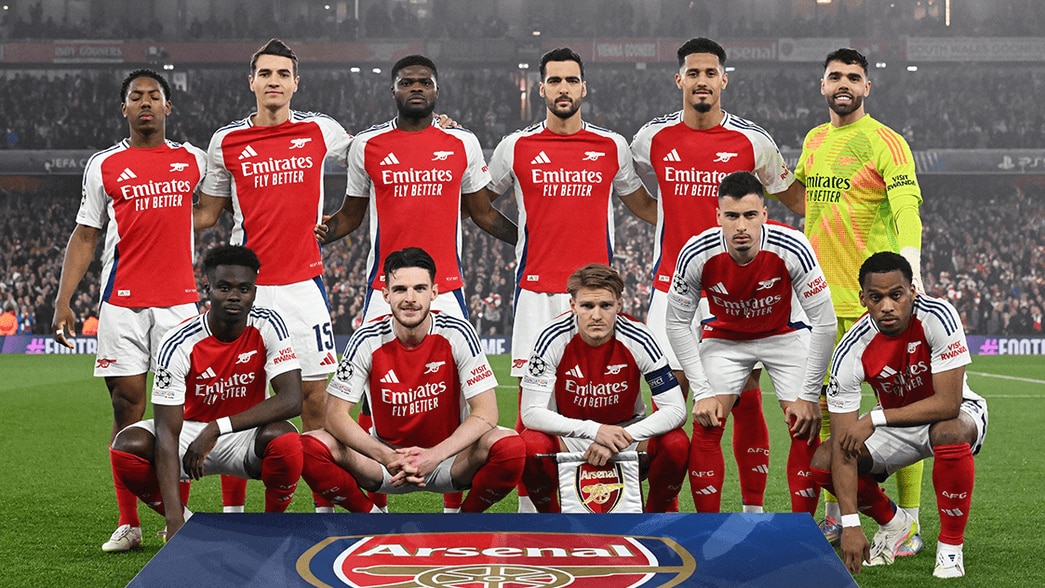
By stripping away emotion, reputation and romance, football supercomputers promise something intoxicatingly simple: cold, mathematical truth. Feed them thousands of variables—results, goal differentials, squad depth, historical performance under pressure—and they will tell you who wins Europe’s biggest prize. According to the latest supercomputer projections, that prize is heading to North London.
The model forecasts Arsenal lifting the UEFA Champions League trophy for the first time in their history, defeating Paris Saint-Germain 2–1 in the final in Budapest. More striking than the headline, however, is the route the machine predicts: a brutal gauntlet of Europe’s elite that Arsenal survive not by dominance alone, but by resilience, marginal gains and nerve-shredding penalty shootouts.
The logic behind the prediction
Supercomputer models typically simulate the remainder of the tournament tens of thousands of times. Each match is not treated as a single event but as a probability cloud, shaped by attacking output, defensive efficiency, squad rotation patterns, travel fatigue and knockout-stage variance. Crucially, reputation counts for nothing unless it translates into repeatable performance indicators.
Arsenal’s perfect league-phase record significantly boosts their probability curve. Unbeaten runs feed the model two advantages: a higher expected-goals baseline and a psychological “momentum factor” derived from historical data showing teams that win early tend to outperform their seasonal averages in knockouts.
Arsenal’s projected path: survival, not supremacy
The supercomputer does not paint Arsenal as untouchable. Quite the opposite. It predicts volatility.
In the last 16, Arsenal are forecast to outscore Borussia Dortmund 9–4 on aggregate—an open, high-event tie that suits Mikel Arteta’s positional attack and wide overloads. The quarter-final against Inter Milan is where the narrative shifts. The model projects a 4–4 aggregate draw, decided on penalties. That matters. Data shows teams that survive an early shootout often outperform expectations later, having already absorbed the psychological shock that breaks others.
The semi-final projection—Arsenal edging Barcelona 4–3 over two legs—is arguably the most controversial outcome. Barcelona’s elimination of Liverpool and Newcastle in earlier rounds marks them as the tournament’s most efficient “giant-killer” in the model. Arsenal progressing suggests a narrow tactical edge: defensive compactness against transition-heavy sides, rather than raw attacking firepower.
PSG: dominance without balance?
Paris Saint-Germain’s route to the final is projected as emphatic. The model has them demolishing Chelsea, brushing aside Atlético Madrid and annihilating Bayern Munich 7–0 on aggregate in the semis. On paper, PSG look unstoppable.
So why do they lose the final?
The supercomputer flags a recurring pattern in PSG’s simulated runs: late-game defensive regression. While PSG’s attacking metrics remain elite, their probability of conceding after the 70th minute spikes against teams with structured possession and disciplined pressing triggers—precisely Arsenal’s profile.
In thousands of simulations, Arsenal’s ability to control tempo late in matches marginally outweighs PSG’s explosiveness. The difference is not star power, but control.
Five Premier League clubs are projected to reach the last 16, underlining England’s depth. Yet only Arsenal advance beyond the semi-finals. Manchester City, despite crushing Real Madrid 5–1 in the last 16, are predicted to fall to Bayern Munich. Liverpool collapse against Barcelona. Chelsea and Tottenham exit on fine margins, with Spurs losing on penalties.
The model suggests congestion, not quality, is England’s hidden weakness. Teams balancing domestic title races and European ambitions show a measurable drop in late-stage efficiency. Arsenal’s projected success implicitly assumes superior rotation management and injury avoidance—factors often overlooked in fan debate but heavily weighted by machines.
One of the most revealing aspects of the prediction is how often penalties decide elite ties. Arsenal and Atlético, Dortmund and Real Madrid—all pushed to spot-kicks. The supercomputer does not see penalties as random. Historical conversion rates, goalkeeper anticipation patterns and shootout experience all tilt probabilities by small but decisive margins.
In Arsenal’s case, those margins accumulate. They do not dominate Europe in the simulations. They endure it.
Supercomputer predictions are not prophecies. They are mirrors, reflecting how modern football rewards structure, repeatability and risk management over aura. Arsenal’s projected triumph says less about destiny and more about optimisation.
If the machine is right, history will not remember this Champions League as a coronation, but as an exercise in survival—won not by the loudest attack or the most feared names, but by the team that made the fewest catastrophic mistakes when the margins collapsed.
And that, perhaps, is the most unsettling conclusion of all: in the age of algorithms, Europe’s biggest nights may belong not to the romantics, but to the best-managed probabilities.