
By Samson Wire
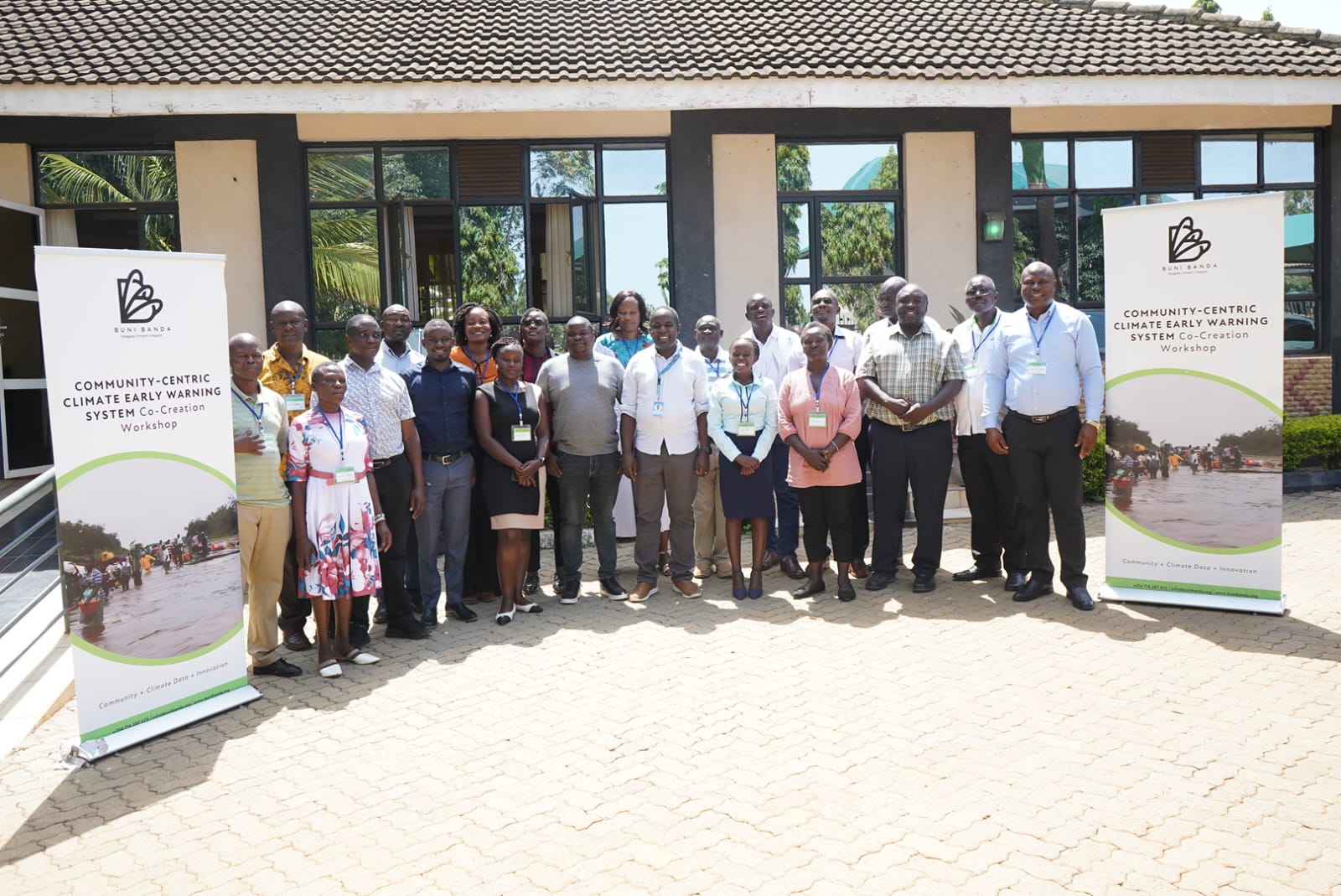
Siaya County is positioning itself at the frontline of climate and health resilience after a high-impact three-day Multi-Hazard Warning System Co-Creation Workshop concluded with significant technical gains and a clear roadmap for action.
Participants drawn from Environment, Climate Change, Indigenous and Local Knowledge (ITK), Health, Disaster Management, Media, ICT, County Administration, and the Project Technical Team wrapped up intensive deliberations aimed at developing robust modules for detecting and responding to climate- and health-related hazards.
The workshop was conducted under the stewardship of Buni Banda, in partnership with the Siaya County Government, Kenya Medical Research Institute (KEMRI), Charité University, climate change experts, media practitioners, and project specialists.
The co-creation process focused on building a trusted, timely, and actionable multi-hazard early warning system to strengthen Siaya’s preparedness against floods, extreme heat, climate-sensitive diseases, and other emerging threats.
Working in structured technical groups with clear rules and processes, participants designed alert mechanisms to ensure warnings are:
Accurate
Timely
Action-oriented
Easy to understand and use
The system is being tailored to protect lives, health, and livelihoods, especially for communities most exposed to erratic weather patterns and disease outbreaks.
A major breakthrough came in system design, where the technical team agreed on:
Simple, clear operational modules for ease of use
Predictable longitude and latitude mapping for ground temperature measurement
GPRS-enabled coordinates to ensure precise location identification of hazards
These features will allow faster translation of data into real-time alerts for communities and decision-makers.
To eliminate guesswork and panic, participants adopted a recognized trigger-role template, structured as follows:
Forecast likelihood: possible / likely / very likely
Confidence levels: low / moderate / high
Time windows: short-term (24–72 hours)
Community observations: type of cues, number of independent reports, and consistency with forecasts
Based on this evidence, alert levels will be issued to communities, chiefs, media houses, weather stations, meteorological officers, and county disaster and health officials for immediate action.
Crucially, the system will not just warn—it will guide action. Alert messages will advise residents on practical precautions against hazards such as:
Flooding
Malaria outbreaks
Extreme heat waves
Drought
Each message will also offer forward-looking solutions to reduce vulnerability to future risks.
The design engineer will now integrate the agreed improvements into a pilot multi-hazard warning system. Once tested and refined, the system will be:
1. Piloted
2. Disseminated
3. Fully handed over to the Siaya County Government as the final owner and user
When operational, the system is expected to transform how Siaya responds to health and climate shocks, enabling short-term action plans that reduce losses, save lives, and strengthen community resilience.
As climate risks intensify, Siaya’s bold investment in science-driven, people-centered early warning systems signals a county ready not just to react—but to anticipate and act.