
By Hope Barbra
The construction of the Standard Gauge Railway (SGR) Phase 2B and 2C from Naivasha to Kisumu and onward to Malaba is expected to begin in March this year.
Kisumu Governor Prof Anyang Nyong’o wrote on his social media platforms that after a consultative meeting with Kenya Railways and the community, the project is expected to begin next month.
He said the 269-kilometre extension from Suswa/Naivasha to Kisumu will include approximately 83 kilometres within Kisumu County, running from Sondu through Ahero to Kisumu Town and continuing toward Malaba via Kisumu West Sub-County.
“We held a consultative meeting with key stakeholders, including Members of Parliament and Members of County Assembly from affected areas in Kisumu County.
The meeting brought together leadership from Kenya Railways led by Managing Director Phillip Maingi, senior officials from the National Land Commission, and representatives of the National Government led by Regional Commissioner Flora Mworoa. Discussions focused on compensation for Project Affected Persons (PAPs), youth participation in construction, and other project impacts,” he said.
Nyong’o said the county government’s priorities are clear and include meaningful local participation, job creation for youth and skilled professionals, inclusion of local enterprises in procurement and supply chains, responsible environmental management, fair and transparent engagement with affected communities, and alignment of the railway corridor with sustainable urban and industrial planning.
“We resolved that all relevant agencies will conduct grassroots consultations in local villages as implementation begins, ensuring communities are directly engaged in this transformative project,” he said.
Maingi assured regional leaders that the corporation was committed to ensuring that the construction of the line—classified as a Category A project—will strictly adhere to all regulatory requirements while prioritizing public safety.
“The infrastructure and facilities affected along the corridor will be relocated where necessary, and the corporation plans to undertake various Corporate Social Responsibility initiatives to support communities affected by the project,” he said.
Nyong’o and technical teams conducted a site visit to the proposed Standard Gauge Railway (SGR) terminus in the Kibos area of Kisumu.
The visit enabled stakeholders to assess the proposed location and gain first-hand insight into the scope of the planned infrastructure and its anticipated impact on regional connectivity and trade.
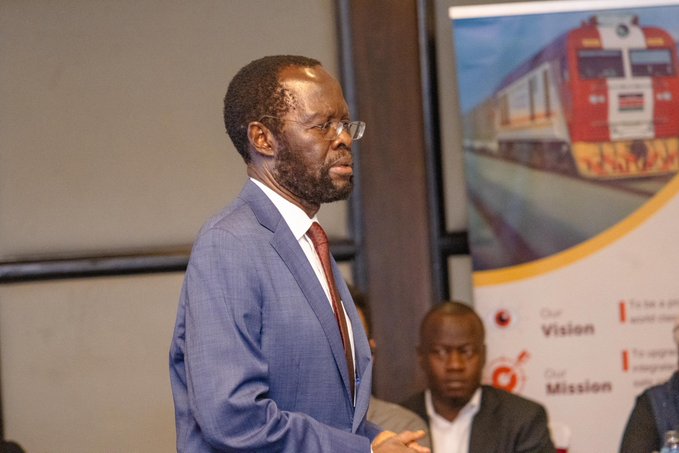
Kenya Railways’ stakeholder consultative forum in Kisumu County brought together regional leadership to deliberate on the upcoming construction of the Standard Gauge Railway (SGR) Phase 2B project.
The forum brought together officials from the National Land Commission, Members of Parliament, and Members of the County Assembly to discuss the anticipated socio-economic impact of the project in the region.
The proposed SGR Phase 2B project will span approximately 264 kilometres, forming a critical link in the railway network connecting the region to the broader national and regional transport system.
Key components of the project will include:
- 79 railway bridges with a combined length of approximately 43 kilometres.
- 8 tunnels with a total length of 14.26 kilometres.
- 376 culverts spanning approximately 7 kilometres.
- 26 stations in the initial phase, comprising one major station, six intermediate stations, and eighteen crossing stations, as well as one freight port facility.
- An 8.68-kilometre branch line linking the main railway to the proposed Kisumu Port, which will include one bridge and eight culverts.
Once completed, the line is expected to significantly enhance freight and passenger movement, strengthen intermodal connectivity between rail and lake transport on Lake Victoria, and stimulate economic growth in the Lake Region and beyond.
Acknowledging the significant economic contribution of the Metre Gauge Railway in the region, Governor Nyong’o noted that the SGR Phase 2B will mark a major advancement in transport capacity, efficiency, speed, and reliability.
He expressed optimism that residents of Kisumu will greatly benefit from the project through employment opportunities during construction and in the long term.
The Governor further emphasized that the project will elevate Kisumu’s strategic role as a logistics hub linking Kenya with neighbouring countries including Uganda, Tanzania, Rwanda, and South Sudan.
“The corridor is expected to expand regional trade, lower the cost of doing business, stimulate industrial parks, strengthen agricultural value chains, and catalyze new investments in warehousing, cold storage, fisheries, and manufacturing,” he said.
Also present at the meeting were Members of Parliament including Shakeel Shabbir, Rosa Buyu, and James Onyango K’Oyoo, alongside Members of the Kisumu County Assembly.
The leaders pledged their support for the project, citing its significance to the people of Kisumu. They commended Kenya Railways and the National Land Commission for holding the joint forum and urged them to conduct more engagements at the grassroots level to ensure the involvement of all Project Affected Persons (PAPs).
Representing the National Land Commission, Director Joel Ombati outlined the land acquisition and compensation process, emphasizing that due diligence will be conducted and that all individuals displaced by the project will receive fair and lawful compensation.