
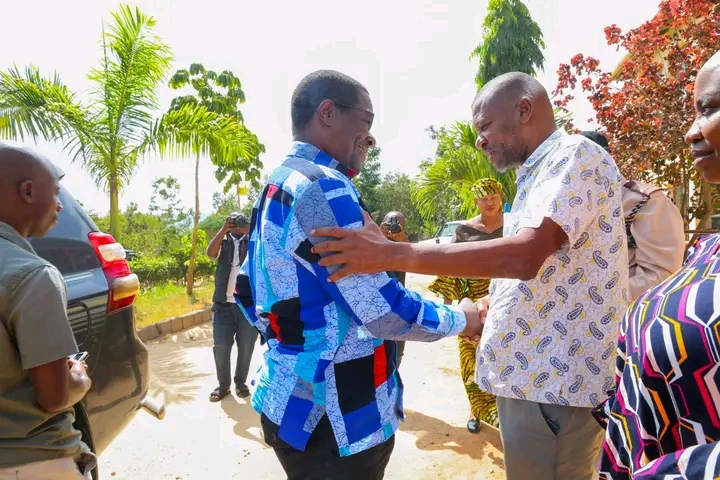
Cabinet Secretary of Energy and Petroleum James Wandayi kicked off his working tour of Taita Taveta County with a purposeful courtesy call on Governor H.E. Andrew Mwadime and Hon. Lydia Haika Mizighi, the County Woman Representative, setting a tone of collaborative governance that resonates deeply in Kenya’s devolved system. This visit was no mere formality; it marked a pivotal moment where national leadership intersected with local aspirations, highlighted by the delightful ratification of the Taita Taveta County Youth Service Bill, 2025 into law. As Wandayi himself noted, he briefed the leaders on current and upcoming energy projects tailored for the county, underscoring a strategic alignment between youth empowerment and sustainable energy infrastructure. In a nation where youth unemployment hovers around 35% and energy access remains uneven, this convergence is not just symbolic—it is a blueprint for #PoweringTheNewKenya, a vision that transforms Taita Taveta from a mineral-rich but underdeveloped region into a hub of innovation and opportunity.
The ratification of the Youth Service Bill, 2025, stands as the crowning achievement of this engagement, a legislative milestone that Governor Mwadime and Woman Rep Mizighi have championed amid grassroots calls for structured youth involvement. This bill, now law, mandates a comprehensive youth service program that integrates training, deployment, and incentives for young people aged 18 to 35, drawing inspiration from successful models like the National Youth Service (NYS) but localized to Taita Taveta’s unique needs. Imagine a cohort of 5,000 youths annually funneled into sectors like agribusiness, mining beneficiation, tourism, and now crucially, renewable energy—skills that address the county’s 60% youth joblessness rate while harnessing its vast solar potential and geothermal prospects near the Tsavo region. Wandayi’s presence at this ratification lent national weight, signaling that the Energy and Petroleum Ministry views youth service not as charity but as a pipeline for a skilled workforce ready to operationalize projects like the proposed 50MW solar farm in Voi and grid extensions to remote pastoralist communities. This is transformative politics: where devolution meets national ambition, turning idle youth into engineers, technicians, and entrepreneurs who will light up homes and power industries, reducing reliance on erratic diesel generators that have long plagued the county’s economy.
Delving deeper into the energy briefing, Wandayi outlined initiatives that promise to electrify Taita Taveta’s growth trajectory. Current projects include the ongoing expansion of the Kenya Electricity Transmission Company (KETRACO) lines from Maungu to Mwatate, boosting capacity by 20MW to serve over 50,000 households previously in darkness. Upcoming ventures are even more ambitious: a hybrid solar-wind installation at Ngangao Hills, leveraging the county’s windy ridges and abundant sunshine for 100MW clean energy, and exploratory geothermal drilling in partnership with Geothermal Development Company (GDC) around the Chala Caldera. These are not abstract plans; they are funded through the Last Mile Connectivity Project and green bonds, with timelines pegged to 2027 completion. For Taita Taveta, where only 45% of the population enjoys reliable electricity—far below the national 75% average—this means agro-processors in Wundanyi can chill milk without spoilage, miners in Kuranze can beneficiate titanium sands on-site, and tour operators in Voi can promote night safaris in Tsavo East without blackouts. Wandayi’s tour emphasizes integration: youth trainees from the new bill will receive certifications in solar panel installation and smart grid management, creating a symbiotic loop where local talent fuels national energy security. This approach counters the historical marginalization of coastal counties, where resource curses like unregulated mining have overshadowed development, positioning Taita Taveta instead as a model for the #PoweringTheNewKenya hashtag—a rallying cry for equitable, sustainable progress.
Yet, the true power of Wandayi’s visit lies in its political and social ripple effects, fostering unity in a county long fractured by ethnic tensions and leadership rivalries. Governor Mwadime, a seasoned administrator from the Taveta sub-county, and Mizighi, a vocal advocate for women’s and youth quotas, represent a united front that transcends party lines, much like Wandayi’s own UDA affiliation bridges with local dynamics. Their joint reception of the CS exemplifies the maturity of devolution under the 2010 Constitution, where county assemblies ratify bills like the Youth Service Act with input from over 200 public participation forums, ensuring buy-in from the Dawida, Taita, and Taveta communities. This collaboration debunks narratives of national-county friction, proving that when leaders prioritize people over politics, outcomes like the bill’s passage—unanimously approved after amendments for stipend increases and gender parity—emerge. Moreover, it spotlights women like Mizighi, whose role in pushing for 30% youth quotas in service deployment amplifies female voices in a male-dominated energy sector. Nationally, this sets a precedent: as Kenya races toward 100% electrification by 2030 per Vision 2030, counties like Taita Taveta could export skilled youth to national grids, easing urban migration pressures and stabilizing President Ruto’s Bottom-Up Economic Transformation Agenda (BETA).
Critically, however, this momentum demands vigilance against pitfalls that have derailed similar initiatives elsewhere. The Youth Service Bill must sidestep NYS scandals of yesteryear by embedding anti-corruption clauses, digital tracking for stipend disbursements, and partnerships with TVET institutions for verifiable skills certification. Energy projects, too, require community land safeguards to prevent displacements seen in Turkana’s wind farms, with revenues from the upcoming 40MW Kasigau Solar Plant ringfenced for county funds via the Shared Prosperity Fund. Wandayi, as CS, should champion public-private models involving KenGen and IPPs like powerHive, ensuring locals own at least 20% stakes as mandated by the Energy Act 2019. Governor Mwadime’s administration, already advancing the Taveta Industrial Park, can integrate these by zoning youth service recruits into value chains—think youth-led cooperatives processing hill rice under solar-powered dryers or gemstone polishers trained in energy-efficient machinery. Mizighi’s influence will be key in advocating for girl-child inclusion, countering dropout rates exacerbated by blackouts that force evening study by kerosene lamps.
In essence, Wandayi’s working tour transcends a single courtesy call; it is a catalyst for Taita Taveta’s renaissance, weaving youth service with energy revolutions to forge economic resilience. As the county’s gypsum mines, soda ash deposits, and wildlife corridors unlock under reliable power, #PoweringTheNewKenya becomes tangible—a Kenya where no child studies in darkness, no farmer loses produce to spoilage, and no youth idles in despair. This is the devolved promise fulfilled: leaders like Wandayi, Mwadime, and Mizighi showing that strategic partnerships yield dividends for the forgotten frontiers. For Taita Taveta, the lights are coming on, and with them, a brighter, self-reliant future beckons.
James Kilonzo Bwire is a Media and Communication Practitioner.
