
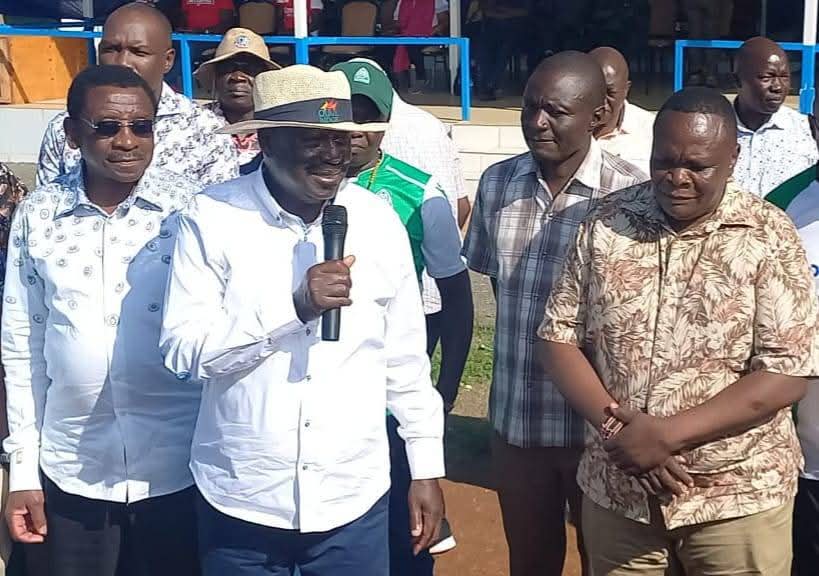
In Siaya politics, the loudest signals are often the quietest whispers. As the county inches toward the 2027 general election, one name has steadily risen from corridor chatter to mainstream conjecture: Dr. Nicholas Kut Kochogo. In political joints, Bodaboda shades, and ODM-adjacent circles, the question is increasingly asked—is Kut quietly positioning himself as Governor James Orengo’s preferred running mate? Or is this simply the rumour mill doing what it does best: projecting intent where none has been declared?
What is not in dispute is Kut’s growing visibility. Currently serving in the County Government of Siaya within the Department of Energy and Public Works, Dr. Kut has cultivated a reputation as a behind-the-scenes workhorse—technocratic, mobile, and politically alert. Supporters credit him with helping drive strategic planning that has accelerated road works and energy interventions under the Orengo-led administration. His outreach to youth groups and the Bodaboda sector—particularly initiatives framing riders as first responders in accident-prone zones—has further burnished his image as a leader attuned to lived realities.
This profile has fuelled talk that Kut is edging ahead of other names whispered for the deputy governor slot. In grapevine politics, he is described as a “scorched-earth tactician”—a slightly paradoxical label for a man also portrayed as a peacemaker and trusted errand-runner for the governor. Pundits speculate that his networks within ODM, coupled with his administrative background and cross-county reach, could make him a strategic bridge-builder at a time when Siaya politics is marked by factional undercurrents and external pressure.
Yet, journalism demands balance—and skepticism.
Two other figures, Obiero Otare and Joseph Ogutu, continue to surface as credible alternatives, each bringing a different political grammar to the table. Otare is often cited for institutional depth and steadiness, a quality prized in a deputy governor expected to anchor continuity rather than command headlines. Ogutu, on the other hand, is viewed by some as offering broader ideological alignment and grassroots acceptability without the polarising baggage that can trail more visible power brokers.
This is where questions about Kut’s suitability emerge—not as verdicts, but as fair interrogations. His political career, while energetic, has not been without bruises. His much-talked-about run for the Alego-Usonga parliamentary seat, where he was tipped by supporters to win but ultimately lost, still invites debate about electoral translation: does popularity in networks and sectors reliably convert into countywide ticket balance?
There is also the matter of optics. Kut’s proximity to power—his closeness to Governor Orengo and reported role in sensitive political errands—can be read two ways. Admirers see trust and loyalty; critics wonder whether such closeness blurs the line between independent deputy material and an extension of the governor’s inner circle. In volatile political environments, deputies are often expected to complement, not mirror, the principal.
Regionally, Kut’s roots in the populous Alego-Usonga Constituency are considered a numerical advantage. His rapport with youth, women, and the informal transport economy across Gem, Ugunja, Ugenya, Bondo and beyond adds to his appeal. Business leaders, too, reportedly view him as accessible and pragmatic. Still, Otare and Ogutu’s backers quietly ask whether breadth should trump intensity—whether a deputy governor ought to be less a political engine and more a stabilising keel.
Complicating the calculus further is the unsettled gubernatorial field itself. While Governor James Orengo is widely seen as a front-runner should he seek another term, other forces hover on the periphery: Ugenya MP David Ochieng (MDG), Deputy Governor Dr William Oduol, former Rarieda MP Eng. Nicholas Gumbo, and now Jaoko Oburu Odinga, among others. In such a fluid landscape, declaring a preferred running mate—explicitly or implicitly—would be premature.
Indeed, no official signal has been sent. The deputy governor slot remains conspicuously undeclared, making the singular prominence of Kut’s name all the more intriguing—and suspect. Is it organic momentum, or strategic leakage? Is Kut dancing on the hedge, or being placed there by enthusiastic allies?
For now, the story remains firmly in the realm of postulation. Siaya’s rumour mill is active, not authoritative. Political seasons have a way of elevating some names early, only to rearrange the deck at the last minute.
As 2027 approaches and party jigsaws shift, one thing is certain: the deputy governor question will not be settled by whispers alone. Until then, Dr. Nicholas Kut Kochogo’s rise—real or rumoured—remains a fascinating study in how power is sometimes announced long before it is claimed.
