
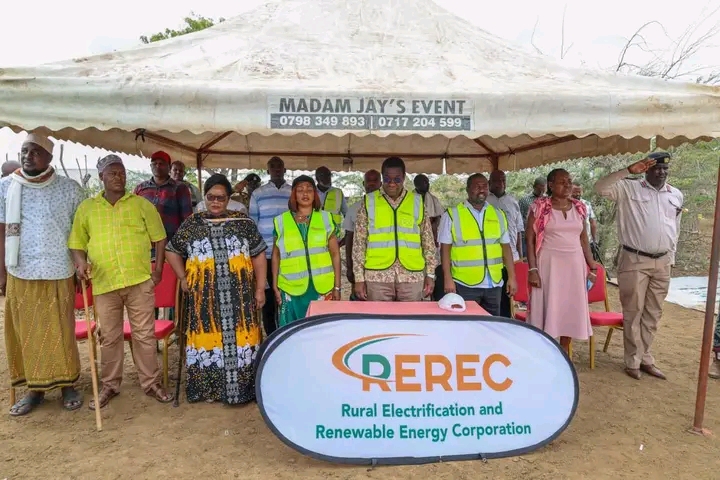
Cabinet secretary of Energy and Petroleum James Wandayi has once again demonstrated visible leadership by commissioning the Last Mile Connectivity Project in Gubani Village, Garsen South Ward, and launching another energy initiative in Diber Village, both in Garsen Constituency, Tana River County. Hosted by area Member of Parliament Hon Ali Wario Guyo, the events go beyond ceremonial milestones and instead reflect a deeper, deliberate effort by the Ministry of Energy to translate national policy into tangible change for communities that have historically existed on the fringes of development. These projects, developed by the Rural Electrification and Renewable Energy Corporation (REREC), are emblematic of Kenya’s broader push toward universal electricity connectivity and highlight how political will, when matched with institutional execution, can reshape rural livelihoods.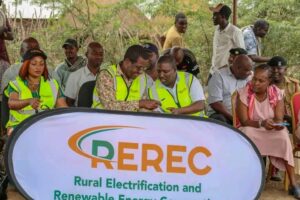
For decades, Tana River County has symbolized the paradox of marginalization in a resource-rich nation. Its people have endured limited infrastructure, sparse social services, and chronic underinvestment, with electricity access remaining a distant promise for many households. In villages like Gubani, nightfall often meant the end of productivity, learning, and commerce. The commissioning of the Last Mile Connectivity Project disrupts this long-standing reality by bringing reliable power directly to homes, schools, health facilities, and micro-enterprises. Electricity in this context is not a convenience; it is a foundational tool for human development. It enables children to study after dark, health workers to operate essential equipment, and families to adopt safer, cleaner alternatives to kerosene and charcoal.
The launch of the Diber Village project further reinforces this momentum, particularly through the integration of renewable and off-grid solutions suited to the unique geography and settlement patterns of Tana River. By leveraging solar-powered systems and localized distribution networks, REREC is demonstrating that rural electrification does not have to follow a one-size-fits-all model. Instead, it can be adaptive, sustainable, and resilient. Wandayi’s presence at both project sites sends a clear message that the national government recognizes the urgency of addressing regional disparities and is prepared to invest political capital and resources to correct them. This approach aligns with the Ministry of Energy’s broader commitment to achieving near-universal access and ensuring that arid and semi-arid regions are not left behind in Kenya’s development trajectory.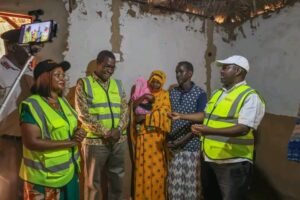
The real significance of these projects lies in their multiplier effect on local economies. In Garsen South Ward, electricity opens the door to value addition in agriculture, fishing, and livestock production—sectors that sustain the majority of households. Cold storage for fish, powered irrigation for small-scale farming, and processing equipment for dairy and honey production become feasible once power is available. Small traders can extend operating hours, youth can engage in digital work, and women’s groups can establish income-generating ventures that were previously impossible. In this sense, energy access becomes a driver of dignity and self-reliance rather than dependency.
Hon Ali Wario Guyo’s role in hosting and championing these initiatives underscores the importance of collaboration between national leadership and local representation. Development is most effective when it is rooted in an understanding of community needs and aspirations. By aligning constituency priorities with national energy goals, the projects in Gubani and Diber avoid the pitfall of becoming abstract statistics and instead manifest as lived improvements in people’s daily lives. This partnership model strengthens public trust and demonstrates that devolution, when supported by strong central institutions, can deliver meaningful outcomes.
At the national level, the Ministry of Energy’s focus on expanding access through REREC reflects a strategic understanding that electricity is the backbone of the Bottom-Up Economic Transformation Agenda. By reducing connection costs and prioritizing underserved regions, the government is lowering barriers to entry for rural households and small businesses. While challenges such as infrastructure vandalism, maintenance capacity, and affordability persist, ongoing investments in smart metering, community engagement, and renewable technologies suggest a willingness to learn and adapt rather than retreat. In counties like Tana River, where nomadic lifestyles and harsh climatic conditions complicate conventional infrastructure planning, flexible and innovative solutions are not optional—they are essential.
Critically, these developments also carry symbolic weight. For communities long accustomed to political promises that fade after public ceremonies, the sight of lights switching on is a powerful affirmation that inclusion is possible. Electricity becomes a visible marker of citizenship, signaling that rural Kenyans are valued participants in the nation’s future. As climate change intensifies pressures on pastoral and agricultural livelihoods, access to clean and reliable energy will play an increasingly central role in adaptation and resilience. Solar-powered water systems, energy-efficient cooling, and digital connectivity can help communities withstand environmental and economic shocks.
The commissioning of the Gubani project and the launch in Diber Village should therefore be understood not as isolated achievements, but as building blocks in a longer journey toward equitable development. They illustrate what is achievable when leadership prioritizes substance over symbolism and when institutions like REREC are empowered to deliver at scale. As Kenya advances toward its long-term development goals, the experience of Tana River County offers a compelling lesson: universal electricity connectivity is not merely about infrastructure expansion, but about restoring balance between center and periphery, opportunity and neglect.
In the glow of newly installed lights across Garsen Constituency, one can glimpse a broader national aspiration taking shape. The work led by Cabinet Secretary James Wandayi, supported by local leadership and institutional capacity, affirms that rural transformation is both possible and necessary. For the people of Gubani and Diber, electricity is no longer an abstract policy objective—it is a daily reality that promises progress, productivity, and hope.
James’ Bwire Kilonzo is a Media and Communication Practitioner.
