
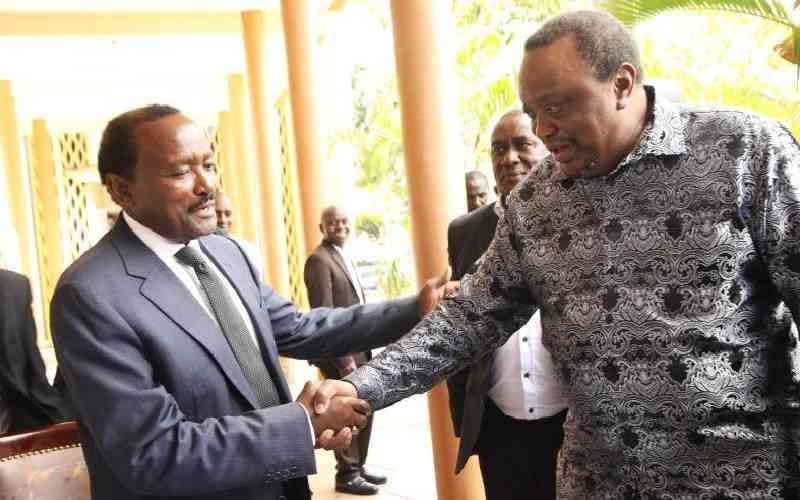
Former President Uhuru Kenyatta’s bold resurgence in opposition politics is sending shockwaves through both camps: rattling a fractured Azimio la Umoja coalition from within while unnerving President William Ruto’s government, which now faces a revitalized foe potentially capable of mounting a serious 2027 challenge.
Uhuru, as Azimio Council Chairman, chaired a pivotal joint meeting of the Coalition Council and National Executive Committee on February 2, 2026, at the coalition’s Nairobi offices. The outcome: sweeping leadership overhaul to fill the vacuum left by the late Raila Odinga.
Wiper leader Stephen Kalonzo Musyoka was named Party Leader, Suba South MP Caroli Omondi replaced Raila’s confidant Junet Mohamed as Secretary-General, and former Nairobi Town Clerk Philip Kisia stepped in as Executive Director, succeeding Raphael Tuju who resigned.
Uhuru framed the moves as urgent and necessary: “These appointments have been necessitated by evolving political circumstances, which call for prompt and strategic leadership enhancements.”
Kalonzo embraced the role with resolve. “I graciously accept my appointment as Party Leader of Azimio La Umoja One Kenya Coalition,” he declared on X. “I thank our chairman, President Uhuru Kenyatta… I pledge principled leadership focused on national renewal.”
Yet the reshuffle has ignited fierce resistance inside Azimio. ODM—the coalition’s largest former anchor—branded the changes “irregular,” “unconstitutional,” and a blatant overreach by Uhuru, insisting no proper consultation occurred with key stakeholders like Raila’s brother Oburu Odinga. In a formal protest to the Registrar of Political Parties, ODM Executive Director Oduor Ong’wen demanded suspension, arguing Uhuru lacked authority under the coalition agreement. Other affiliates, including the National Liberal Party and United Democratic Party, echoed the rejection, terming the shifts “null and void” and threatening legal action.
The standoff escalated when Kalonzo accused State House of instructing the Government Printer to block gazettement of the new lineup—fueling claims of government interference to cripple opposition unity.
On the government side, President Ruto has responded with unmistakable disdain mixed with strategic dismissal. Mocking the revival efforts, he declared Azimio “dead without ODM” and incapable of survival post-Raila’s passing and ODM’s pivot toward a broad-based arrangement with the ruling side. Speaking in Nairobi, Ruto scoffed: “Azimio without ODM is dead… I will trounce Azimio in the morning,” signaling confidence that internal chaos and ODM’s drift have neutralized any real threat to his 2027 re-election.
Analysts see Uhuru’s intervention as a calculated bid to sideline ODM loyalists, elevate Kalonzo as a credible anti-Ruto flagbearer, and rally a “one-term” coalition against the incumbent—potentially disrupting Ruto’s dominance by unifying fragmented opposition forces.
But the double-edged fallout is clear: Azimio risks deeper paralysis and legal battles, while State House grapples with a former president’s return injecting fresh unpredictability into the political arena.
As gazettement remains stalled and accusations fly, Uhuru’s comeback has achieved one undeniable feat—discomfort on both sides of the aisle. Whether it sparks genuine opposition revival or accelerates Azimio’s implosion remains the question Kenya’s power brokers are racing to answer ahead of 2027.