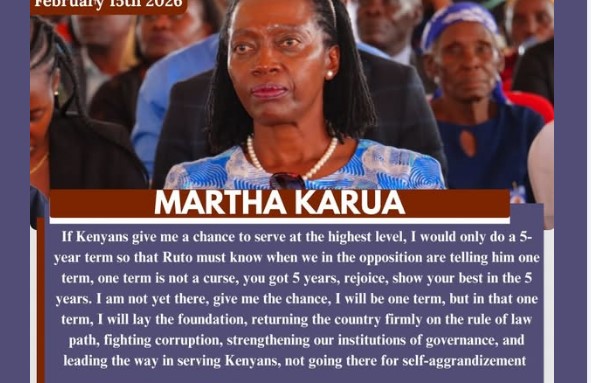
Kenyan politics has once again taken an intriguing turn after senior counsel and opposition figure Martha Karua declared that she would serve only a single five-year term if elected to the highest office in the land.
Speaking to Kenyans, Karua emphasized that a one-term presidency should not be viewed as a curse but as an opportunity to deliver focused, transformative leadership. In an apparent reference to President William Ruto, she argued that five years are sufficient for any serious leader to demonstrate commitment, competence, and tangible results.
Karua stated that if entrusted with leadership, her administration would concentrate on laying a firm foundation for restoring the rule of law, strengthening governance institutions, and aggressively tackling corruption. She maintained that the purpose of leadership should be service to citizens rather than personal enrichment or self-aggrandizement.
Her remarks also underscored a broader message from sections of the opposition: that power should not be treated as an entitlement but as a responsibility bound by accountability and performance. By pledging to serve only one term, Karua positioned herself as a leader focused on legacy and structural reform rather than longevity in office.
The seasoned politician further noted that institutional rebuilding would be central to her agenda. According to her vision, independent institutions must function without political interference, public resources must be safeguarded, and government must operate transparently. She argued that rebuilding public trust requires decisive action and ethical leadership at the top.
Karua’s comments are likely to spark debate across the political divide. Supporters may view the one-term pledge as a bold commitment to principled governance, while critics may question its practicality in a political environment where incumbency often shapes electoral strategy.
As Kenya continues to grapple with economic pressures, governance concerns, and demands for accountability, statements like these signal that the next political contest may revolve not only around personalities but around competing visions of how the country should be led and reformed.